
Our Guide to Stretches for Gardening
We love spending time in our gardens — not only do we get to see our hard work pay off in beautiful ways, but we can feel the difference in our moods and bodies as well!
Working with and being surrounded by plants is incredibly beneficial. Some studies link green, nature-filled spaces to reduced stress, anxiety, and longevity, and others show that community gardens can help people take in more fiber and Vitamin D than they usually would and maintain a more active lifestyle.
Let’s dive into how much of a workout gardening can be for your body, injuries to look out for, and how to avoid those injuries with some simple (but effective) stretches.
Does Gardening Count as Exercise?
If you’re struggling to get your recommended 150 minutes of exercise a week, try heading out into your garden! Digging, mowing, raking, and other garden chores for 30–40 minutes is a great way to meet your daily goal for physical activity, no matter your age or fitness level.
While gardening, we work out multiple muscle groups, including our legs, arms, and core. According to Dr. I-Min Lee, a professor of medicine at Harvard Medical School, “Many yard and gardening tasks require enough effort to count as moderate-intensity exercise.” Dr. Lee also recommends getting in at least two days of muscle-strengthening exercises a week — something that all your mowing, raking, and digging can definitely fulfill!
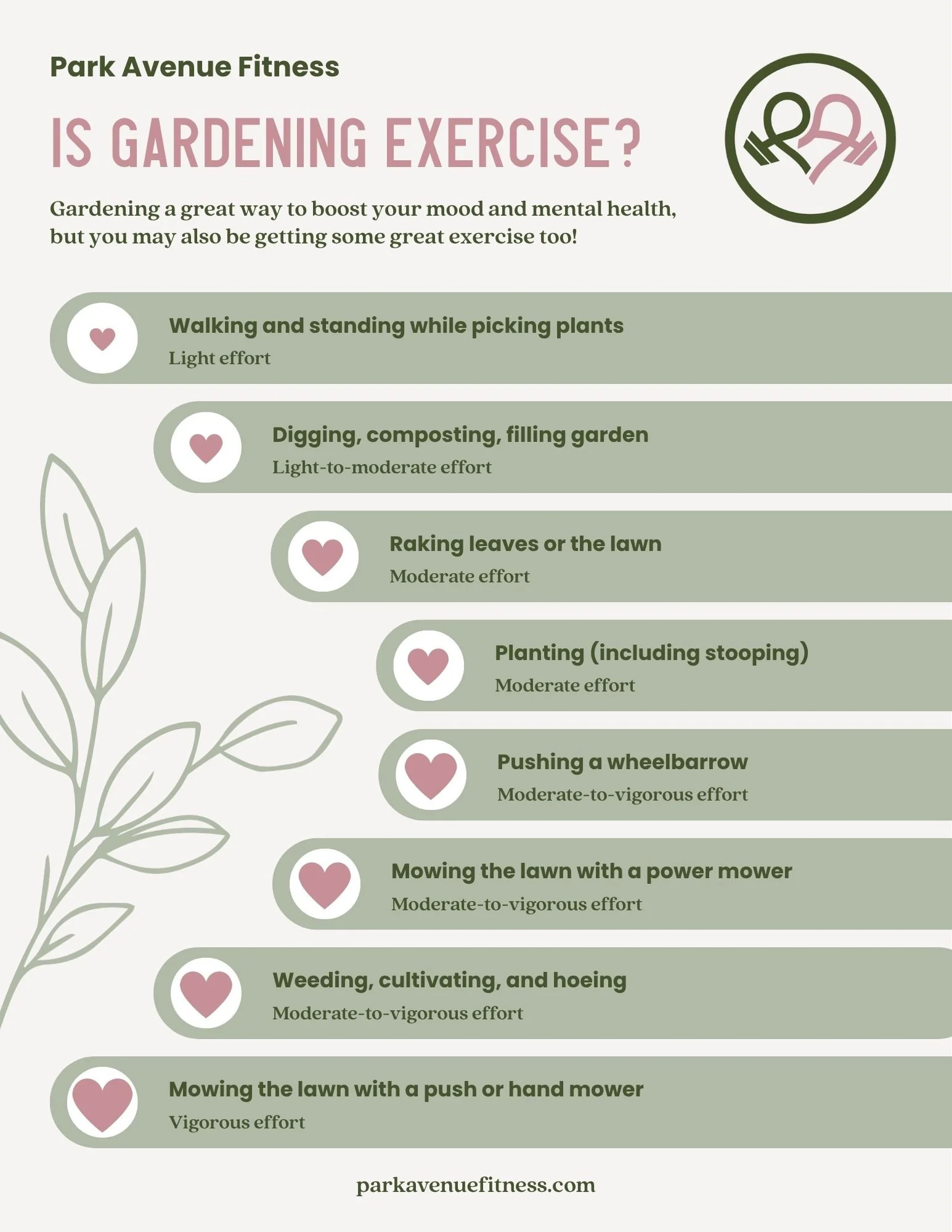
Here’s a quick overview of how much effort it takes to complete typical gardening tasks:
Common Gardening Injuries
Like any workout or physical activity, gardening presents some risks of injury, including:
Cuts, scrapes, and skin tears
Falls, overexertion, heat exhaustion, and sun damage
Muscle and joint stress/strains on the lower back, knees, shoulders, and elbows
However, even the more intense movements while gardening still have a lower risk of injury compared to high-impact exercise like running.
To avoid cuts, unnecessary strains, and sun damage, we recommend getting:
Kneeling pads, rolling garden seat, garden kneeler with arms, garden kneeler with seat
Grabbing/reaching tools, tools with ergonomic handles
Protective clothing like gloves, long sleeves, sturdy shoes, and sun hats
Having the right tools and gear can help you garden more comfortably, but we have some additional tips on how you can make sure your joints and muscles are ready for all that movement.
Stretches for Gardening
To minimize muscle and joint stress, we recommend a quick round of gentle stretches. To get started, try:
Bending your knees to stretch your calves and quads
Touching your toes
Squatting
Rolling your shoulders and stretching your arms to the sky
Stretching your triceps, sides, back, and chest
Doing some side reaches and practice twists
Follow Along With Mary and Sharron
Want to try a quick gardening warm-up with our Park Avenue trainers?
In this three-minute video, Mary shows us some of her favorite stretches for gardening.
Or, take five minutes to try some chair-assisted Gyrokinesis stretches with Sharron!
Remember, you reap what you sow — if you take the time to get your muscles and joints ready, you’ll be able to handle more of what the garden throws at you!
Stay Garden-Ready With Personal Training and Small Group Classes at Park Avenue Fitness!
To get started, browse our classes or contact us to learn more!
Sources:
Harvard Health Publishing (2024)
The Lancet: Planetary Health (2023)
NIH (2018)